The Deceptive Permanence of the River of Five Colors
Caño Cristales is often introduced as the River of Five Colors, a phrase that suggests a permanent feature of the Colombian landscape. In reality, its reds, pinks, greens, yellows, and blues belong to a narrow seasonal interval. The riverbed is usually a clear, rocky stream, and its celebrated appearance emerges only when water levels, sunlight, and the condition of its aquatic vegetation happen to align. The spectacle is therefore less like painted scenery than a brief physiological event, written onto ancient quartzite and erased again by changing weather.
Within the Serranía de la Macarena, three great biogeographical realms meet: the Andes, the Amazon, and the Orinoco. Their convergence creates a mosaic of habitats and evolutionary opportunities, from forest and savanna to riverine niches found nowhere else. To understand the place properly, it helps to look beyond postcard language. A closer field-notebook reading asks how much water covers the bed, how clearly light travels through the channel, how firmly the vegetation is attached, and whether human presence is being kept within the limits this delicate system can tolerate. The broader geographic setting is outlined in this geographical account of Caño Cristales.
The Biology of an Ephemeral Bloom
The principal living agent behind the river”s red and pink display is the endemic aquatic plant Macarenia clavigera, also referred to in official Colombian materials as Rhyncholacis clavigera. It occupies a difficult environment. The river flows across hard, nutrient-poor quartzite, where ordinary rooted plants would struggle to establish themselves. Macarenia is adapted to this austere bedrock, attaching closely to submerged surfaces and maintaining its position where the current is strong enough to dislodge less specialized vegetation.
Its attachment is not decorative but structural. Holdfast-like structures grip irregularities in the rock, allowing colonies to persist in fast water while remaining exposed to the light needed for growth. When conditions are suitable, tissues that may appear subdued green at other times develop intense red or carmine tones. The plant”s pigments, viewed through clear water and over contrasting rock, create much of the river”s famous visual intensity. Other colours are supplied by the blue of the water, pale or yellowish sand, green vegetation, and dark geological surfaces, but Macarenia provides the biological signature.
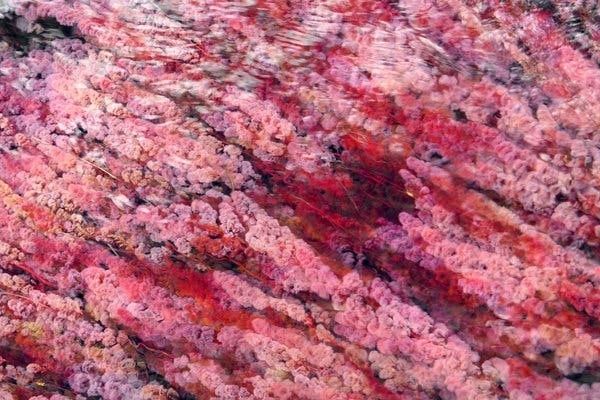
The bloom is governed by a narrow set of physiological pressures. Too much water can submerge the colonies beneath a darker, deeper column and reduce the solar radiation reaching them. Too little water can expose them to desiccation, interrupt growth, and leave their attachment points vulnerable. Sudden increases in current may produce mechanical stress, while prolonged heat and low flow can cause premature senescence. What matters is not simply rain or sun in isolation, but their measured relationship across the riverbed.
- Suitable flow: enough current to keep the plant submerged and supplied, but not so much force that colonies are torn from the rock.
- Clear water: low turbidity allows visible and ultraviolet radiation to reach the plant rather than being scattered or absorbed above it.
- Stable attachment: holdfasts must remain undisturbed on the quartzite, particularly during visitor access and periods of changing flow.
- Seasonal timing: the strongest colours appear during a transition between wetter and drier conditions, not throughout the year.
The Geometry of Flow and Solar Penetration
The river”s visual transformation can be understood as a problem of geometry. During the wettest period, swollen channels carry more water across the bed. The increased depth and turbulence can block or scatter the light required by Macarenia, making the colonies less visible even when they remain present. At the opposite extreme, the dry season may reduce the water column so severely that the plant cannot continue its normal aquatic growth. The celebrated interval lies between these conditions, when water is sufficiently deep to sustain the colonies but sufficiently shallow and transparent for light to reach them.
Water clarity functions like an optical filter. Sediment, turbulence, and depth alter the quantity and quality of radiation arriving at the riverbed. The same colony can therefore look different from one section of channel to another, depending on whether it lies beneath a calm transparent pool, a shallow riffle, or a shaded depression. Visible light determines what the eye perceives, while the plant”s exposure to solar radiation influences its pigmentation and condition. This is why a visit planned only by month can disappoint: rainfall patterns and local river conditions remain decisive.
The following overview offers a practical reading of the river”s principal stages. It is not a fixed timetable, because rainfall, temperature, and water levels vary between years. Official access decisions are made seasonally and may change with biological monitoring and safety conditions.
| River stage | Physical conditions | Likely effect on Macarenia colonies |
|---|---|---|
| High-flow rainy period | Deeper, faster, more turbulent water with reduced light penetration | Colonies may be submerged, visually muted, or stressed by current force |
| Seasonal transition | Moderate depth, clearer water, and stronger access to sunlight | Most favourable conditions for visible growth and vivid pigmentation |
| Low-flow dry period | Shallow channels, warming surfaces, and risk of exposed rock | Growth may decline, senescence may accelerate, and attachment may become vulnerable |
These stages also explain why the river should never be treated as a static photographic set. A red channel seen on one day can appear quieter a short distance away or change markedly after rain. The colour is an expression of current conditions, not a permanent property of the stone. The most attentive visitor therefore observes variation rather than searching for one ideal frame.
Stewardship Under the Canopy of Parques Nacionales
Caño Cristales is no longer approached as an isolated curiosity beyond meaningful oversight. Its opening and management depend on coordination among national park authorities, local institutions, tourism operators, and communities in La Macarena. The 2026 season was announced under the principle “Naturalmente Responsable,” with access connected to environmental assessment and regulated tourism. In official guidance, the opening period extends from May 29 through December, but particular trails and attractions remain subject to conditions on the ground.
This distinction is important. A calendar date does not guarantee that every route, pool, or viewpoint will be available. Authorities assess the state of the vegetation, rainfall, trail conditions, and broader safety considerations before permitting access. The official framework described by Parques Nacionales Naturales de Colombia emphasizes authorized guides, officially recognized services, respect for local communities, and protection of both ecological and archaeological features.
Chemical contamination is among the least visible risks. Sunscreen, insect repellent, body oils, soaps, and similar products can enter shallow water directly from visitors. In a system where Macarenia grows in close contact with the riverbed, even small inputs deserve caution. The practical instruction is straightforward: do not apply sunscreen or other chemical body products before entering the river area, and follow local guidance concerning swimming and contact with the water. This is not an aesthetic preference. It is a precaution intended to protect delicate plant tissues and their holdfasts.
- Use an authorized tourism agency and follow the assigned guide.
- Check current access conditions rather than assuming that a previous season”s route remains open.
- Keep sunscreen, insect repellent, soaps, and other chemical products away from the river.
- Carry drinking water in a reusable container and remove all waste.
- Leave rock art, archaeological remains, plants, and geological features untouched.
- Respect visitor limits, designated trails, and temporary closures without attempting alternatives.
The scale of stewardship is also social. Tourism connected with Caño Cristales supports many families in La Macarena, and responsible visitation can help sustain guiding, transport, hospitality, and ecological restoration. Conservation is strongest when it protects both the river”s biological thresholds and the community relationships that make careful access possible.
Field Observations for the Mindful Naturalist
Travelers generally reach the protected landscape through La Macarena, then continue with guided arrangements into the national park. The routes are not casual promenades. Official information describes trails of medium to high difficulty, commonly covering approximately 5 to 10 kilometres and requiring about 5 to 7 hours. Suitable footwear, physical preparation, sufficient water, and a willingness to accept route changes are more valuable than an elaborate photographic plan.
Once at the river, observation should begin with restraint. Bare rock may appear durable, but it is also the surface on which Macarenia colonies establish themselves. A careless step can damage more than a visible patch of colour, particularly in shallow eddies where plant growth is easy to overlook. The most meaningful visit allows the river to remain a functioning habitat rather than becoming a stage arranged around the visitor.
- Remain on designated trails, wooden walkways, and approved access points, even when an unmarked route appears to offer a better view.
- Place feet only on clearly bare, stable rock when guides permit movement near the water, avoiding submerged vegetation and thin mats.
- Keep physical distance from shallow eddies, pools, and colonies instead of entering them for photographs or closer inspection.
- Watch how colour changes along the current, comparing deep circular potholes known as los hoyos gigantes with faster cascades and riffles.
- Photograph without touching, collecting, feeding wildlife, or moving stones, and accept that changing light may produce a quieter image.
Micro-habitats reward patience. Deep potholes can hold calmer, darker water, while cascades expose the riverbed to brighter, broken light. A red patch may intensify where the plant receives suitable radiation, then soften beside a shaded channel or a section disturbed by stronger flow. These transitions are not imperfections in the spectacle. They are the evidence that the river is alive, variable, and governed by local conditions.
Preserving the Pulse of an Unrepeatable Current
The crimson hue of Caño Cristales is best read as a vital sign of equilibrium. It indicates that a specialised plant has found a temporary balance among water depth, current, sunlight, clarity, bedrock, and seasonal timing. Remove one of those conditions and the colour may fade, the plant may weaken, or the visible bloom may fail altogether. The river is not permanently painted; it is briefly demonstrating that several demanding processes are working together.
For contemporary travelers, that understanding carries a clear responsibility. The right response to a fragile landscape is not to demand permanence from it, but to accept its terms: regulated access, clean habits, careful footing, and readiness for a less colourful day. Caño Cristales becomes more remarkable, not less, when its beauty is understood as conditional. Its deepest wonder lies in the precision of its survival, a brief red pulse maintained only when water, light, rock, and human restraint remain in balance.