When Art Grounds Itself in Living Soil
Instituto Inhotim, in Brumadinho, Minas Gerais, is often described as an open-air contemporary art museum and botanical garden. That description is accurate, but incomplete. Inhotim is also a test of whether a cultural institution can become part of an ecological system rather than simply occupying one. Its galleries, sculptures, lakes, paths, forest fragments, cultivated collections, and educational programs form a landscape in which artistic experience depends on the vitality of the ground beneath it.
The setting matters. Inhotim lies within a transition between Brazil”s Atlantic Forest and Cerrado, two biodiverse and heavily threatened biomes with distinct ecological histories. The institution”s pavilions therefore stand within an ecocline, a zone of gradual environmental change rather than a single, uniform landscape. This makes the architecture more than a sequence of objects in a garden. It becomes a mediator between climate, canopy, soil, water, movement, and attention. A closer look at Inhotim asks a demanding question: can cultural curation advance genuine ecological repair, or does it merely aestheticize nature?
The Ecocline of Minas Gerais and the Burle Marx Legacy
Inhotim”s grounds emerged from a long transformation of private land into a public cultural and botanical institution. Garden construction began in the 1980s, while the major landscape project developed by Luiz Carlos Orsini between 2000 and 2004 built upon the work of landscape designer Pedro Nehring. The history is important because the site was not conceived as a neutral platform on which art would later be placed. Its gardens, collections, preserved forest, and visitor routes have been assembled through sustained acts of selection, cultivation, protection, and interpretation.
Roberto Burle Marx”s influence belongs to this broader lineage. His visit to Inhotim in the 1980s helped establish a landscape sensibility in which botanical knowledge and visual composition could coexist without reducing plants to ornamental accessories. The Jardim Pictórico, identified as the institution”s oldest garden, reflects that approach. Designed by Nehring and containing approximately 150 tropical species, including aroids, palms, heliconias, and orchids, it places works by Cildo Meireles and Olafur Eliasson within a living composition. The garden is not merely a frame for art. It demonstrates how planting structure can shape pace, atmosphere, scale, and interpretation.
Today, more than 4,300 botanical species thrive across Inhotim”s approximately 140 landscaped hectares. The figure should not be treated as a simple measure of abundance. Its value depends on how collections are documented, maintained, propagated, and connected to conservation goals. Inhotim”s botanical garden prioritizes rare, endemic, and threatened species, while 75 hectares of forest fragments occupy 56.4 percent of the institute”s total area. The site also borders the 250-hectare Bernardo Paz Private Natural Heritage Reserve. Foundational background on the institution”s cultural footprint and landscape history is available in the Authoritative Source.
- The Atlantic Forest and Cerrado transition requires attention to changing soil, moisture, elevation, and species associations.
- Botanical collections can support conservation and research when their provenance and propagation histories are carefully recorded.
- Landscape composition becomes ecologically meaningful when it protects habitat, supports pollinators, manages water, and communicates environmental knowledge.
Understanding the ecocline changes the way architecture should be curated. A pavilion that works in a dense forest may be inappropriate on an exposed Cerrado edge. A path that seems efficient on a plan may channel runoff across fragile soil. Site-sensitive curation begins by accepting that every building, artwork, and route participates in a pre-existing ecological gradient.
Curating Between Concrete and Canopy
Inhotim”s pavilions are often associated with particular artists, allowing architecture to become an extension of artistic language. Rirkrit Tiravanija”s Palm Pavilion is a telling example. Its restrained metal structure and ordered grid of palms create a deliberate contrast with the surrounding abundance. The pavilion offers a place to gather, rest, interact, and contemplate, while also asking how tropical imagery is constructed, circulated, and commodified. The palms are living material, symbolic material, and spatial material at once.
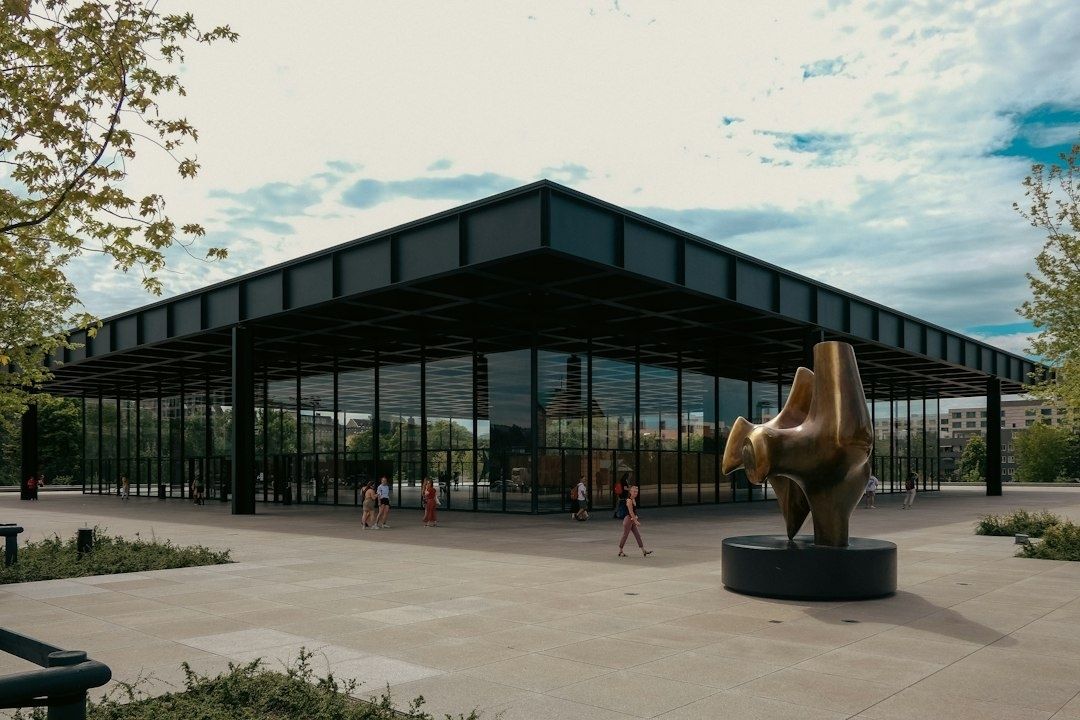
This kind of work dissolves the usual separation between gallery and garden. Light changes across the day; air moves through the structure; shade is produced by both architecture and foliage; humidity and temperature become part of the visitor”s experience. Rivane Neuenschwander”s work at Inhotim offers another form of curatorial permeability. Her exhibition Tangolomango, presented from October 2024 through March 1, 2026, brought together painting, photography, installation, and video in a setting where questions of ecology, history, childhood, and politics could be read against the larger landscape. The exhibition period has ended, but its example remains useful: a pavilion can hold a concentrated body of work without sealing it away from the environmental conditions that give it resonance.
| Gallery model | Relationship with the biome | Curatorial consequence |
|---|---|---|
| Closed white cube | Controls light, air, sound, and temperature | Offers precision and conservation stability, but can mute local climate and ecological context |
| Porous pavilion | Admits filtered light, movement, sound, humidity, and vegetation | Makes environmental change part of the work and requires careful material and maintenance decisions |
| Outdoor installation | Shares exposure with soil, weather, organisms, and visitor movement | Expands interpretation but demands active management of erosion, access, and long-term resilience |
Surrounding flora also performs a thermal and perceptual role. Canopy can lower radiant heat, planting can soften reflected glare, and dense vegetation can make a modest structure feel more remote than its footprint suggests. At the same time, a highly curated planting scheme may create an image of tropical nature that obscures the labor, irrigation, sourcing, and ecological trade-offs behind it. The Jardim Pictórico documentation is a useful reminder that botanical composition carries both aesthetic and institutional responsibilities.
Integrating bespoke exhibition shelters into fragile habitats demonstrates an innovative model of sustainable design that modern cultural projects continually seek to emulate. The lesson, however, is not to reproduce Inhotim”s visual language. It is to study the logic behind it: place buildings where they can reinforce ecological continuity, make environmental conditions legible, and accept that the surrounding landscape is an active collaborator rather than decorative scenery.
The Principles of Meaningful Ecological Restoration
Ecological restoration is more demanding than planting attractive species around a building. Decorative landscaping can produce shade, color, and a convincing impression of nature while leaving degraded soil, simplified habitat, disrupted hydrology, and vulnerable genetic diversity untouched. Authentic recovery asks whether ecological functions are returning, whether native communities can persist, and whether the system can adapt to environmental change.
The Society for Ecological Restoration”s international framework is valuable because it treats restoration as a process with reference ecosystems, stakeholder knowledge, measurable goals, and adaptive management. Its principles address the highest attainable level of recovery, the importance of diverse knowledge, and the need to place restoration within a wider continuum of restorative activities. For civic landscape initiatives aiming at verifiable habitat recovery, the SER restoration standards provide a rigorous benchmark.
- Define the ecological reference condition without pretending that the past can be reproduced unchanged.
- Record species provenance, survival, recruitment, pollination, soil condition, and hydrological performance.
- Use botanical collections as living repositories, not only as visual displays.
- Include local communities and practical knowledge in decisions about maintenance and access.
- Review outcomes over time and adjust management when evidence shows that an intervention is failing.
Inhotim”s botanical role is especially significant in this regard. The institution maintains, propagates, studies, and disseminates regional and ornamental flora, giving plants a scientific and educational identity beyond their visual appeal. Its conservation work includes endangered species such as Constantia cipoensis outside its natural habitat, a form of ex situ stewardship that may support research, propagation, and possible future reintroduction. Such work does not replace protection in the wild, but it can preserve knowledge and genetic material while broader conservation efforts continue.
The visitor economy introduces a necessary tension. Heavy footfall can compact soil, disturb understory vegetation, widen informal paths, and increase pressure on water and waste systems. Watershed protection therefore belongs within the curatorial brief. Routes should be concentrated where appropriate, surfaces should allow infiltration, and sensitive areas should be given meaningful periods of rest. Inhotim”s public programming, including workshops, guided encounters, biodiversity activities, and transportation initiatives for Brumadinho residents, shows how ecological care can become a social practice rather than a backstage maintenance task.
Practical Directives for Landscape Architects and Cultural Stewards
The most transferable lesson from Inhotim is methodological. Its model cannot be copied simply by commissioning distinctive buildings and surrounding them with ambitious planting. Each project must begin with a close reading of its own climate, soils, hydrology, species, histories, and communities. The pavilion is the visible outcome; the ecological survey and management system are the less visible foundation.
- Survey before siting. Map microclimates, drainage lines, soil compaction, canopy structure, habitat corridors, seasonal water conditions, and endemic or threatened plants before fixing a building footprint. A survey should include field observation across seasons, not only a one-time inventory.
- Design for permeability and reversal. Where conservation requirements permit, favor modular, demountable, repairable, or porous envelopes. Keep foundations and service routes as light as possible, preserve natural drainage, and make future removal or adaptation technically feasible.
- Separate spectacle from ecological performance. A dramatic structure is not automatically sustainable. Assess embodied material, shade, ventilation, maintenance access, lighting, water demand, runoff, and effects on wildlife alongside visual impact.
- Turn maintenance into interpretation. Pruning, seed collection, composting, propagation, soil repair, and invasive-species control can become public ecological workshops. Visitors understand stewardship more deeply when they can see the work that makes a garden resilient.
- Measure biodiversity beside attendance. Track native species persistence, recruitment, pollinator presence, canopy development, soil infiltration, erosion, water quality, and habitat connectivity. Visitor numbers matter, but they cannot stand in for ecological success.
These directives also require institutional patience. Restoration rarely follows the opening schedule of a pavilion. Plants establish at different rates, soils respond slowly, and climate variability can expose weaknesses that were invisible during construction. Adaptive management should therefore be written into budgets, contracts, exhibition planning, and governance structures. A landscape team needs authority to modify paths, planting, shading, or visitor access when monitoring indicates harm.
Public participation should be equally concrete. Inhotim”s gardening training and socio-environmental initiatives suggest a model in which the surrounding community is not treated as an audience located outside the institution. Local residents can contribute knowledge, receive training, shape programming, and benefit from access. This strengthens the ecological project because stewardship becomes distributed across people and practices rather than assigned solely to a specialist department.
Finally, cultural institutions should publish ecological accounts with the same care given to exhibition histories. A transparent annual record might include habitat gains and losses, water use, restoration targets, species survival, maintenance interventions, and unresolved conflicts. Such reporting does not diminish art. It clarifies the conditions that allow art and landscape to coexist responsibly.
Reimagining the Cultural Institution as a Living Sanctuary
Inhotim”s deepest proposition is not that art looks better among trees. It is that a cultural institution can organize attention around interdependence. Its pavilions, gardens, forest fragments, botanical collections, and public programs make the landscape legible as a field of relationships. The institution”s ecological identity remains complex, including the financial and environmental questions that accompany a large destination, but that complexity is precisely what makes the model useful. Ecological claims must be tested against material impacts, not accepted as atmosphere.
For planners, curators, and architects, the next step is to move beyond the white cube as the default civic cultural model. Responsive living infrastructure begins with surveys, reference conditions, modest footprints, porous boundaries, and measurable care. It allows climate and biology to enter the curatorial conversation without turning nature into a backdrop. When a pavilion protects soil, frames seasonal change, supports botanical knowledge, and invites people into responsible attention, architecture does more than house culture. It helps a damaged landscape recover its capacity to live.