Echoes Carved from High Altitude
Across an Andean pass, the charango can sound almost weightless: a bright, shimmering chime that seems to gather the thin mountain air and return it in quick, silver flashes. Its voice is compact but not slight, capable of marking a dance, answering a flute, supporting a singer, or cutting through the layered pulse of drums. The instrument”s small body invites underestimation. Its history does not.
The charango is often introduced as a miniature guitar, yet that comparison conceals more than it explains. Its five double courses, re-entrant tuning, short scale, characteristic strumming, and regional forms place it within a distinct Andean world. Its story leads from the encounter between Spanish string instruments and Indigenous craftsmanship to the cultural movements that made Andean sound a public declaration of belonging. The central transformation is one of sovereignty: a colonial model was not simply copied, but remade until it carried a different memory, purpose, and authority.
Colonial Echoes and the Mestizo Alchemy
After the Spanish conquest, vihuelas, guitars, and related chordophones entered the Andes alongside new religious, political, and economic structures. These instruments supplied models of fretted necks, resonant bodies, and strummed accompaniment, but the conditions of their new environment changed what those models became. Indigenous makers worked with local materials, inherited woodworking knowledge, and musical expectations that did not belong to Europe. The result was not a failed imitation of a European instrument. It was a practical and imaginative act of translation.
The charango is generally dated to at least the eighteenth century, although its precise birthplace remains debated. Some accounts associate its development with southern Peru, while others point toward areas near modern-day Potosí in Bolivia. The most useful historical view allows for several local experiments rather than a single moment of invention. Quechua and Aymara communities incorporated the instrument into courting, festival, dance, and other social settings, while urban mestizo musicians later developed additional forms and repertories. The Grinnell College instrument record describes the charango as a bowl-lute chordophone shaped by both European and pre-Columbian influences.
A comparison with European ancestors makes the transformation clearer. The charango retained recognizable features of the guitar and vihuela family, but compressed them into a higher-voiced, more immediate instrument whose identity depends on paired strings and a distinctive tuning logic. Regional instruments vary in body shape, string material, fret count, tuning, and playing technique. That variation matters because it shows the charango as a living family of instruments rather than a fixed colonial artifact.
| Feature | European guitar and vihuela models | Andean charango traditions |
|---|---|---|
| Body scale | Generally larger bodies and longer scales | Compact bodies and short scales suited to a bright, agile register |
| String arrangement | Varied courses, commonly organized toward a more linear pitch sequence | Five paired courses with regional tuning variations and re-entrant logic |
| Resonator | Wooden bodies shaped through European construction traditions | Historically armadillo shell or carved wood, combined with locally adapted soundboard designs |
| Social use | Courtly, religious, theatrical, and domestic repertories | Courting, festivals, dance, ritual, professional folklore, and cultural activism |
Anatomy of Resonance and Material Memory
Traditional charangos are strongly associated with a resonator made from quirquincho, the shell of an armadillo, covered by a wooden soundboard. The shell”s curved surface gave the instrument a distinctive silhouette and helped preserve the memory of older making practices. Yet material history is never static. Wooden charangos, including instruments carved from a single block or assembled from carefully selected tonewoods, have long formed an important part of the tradition. Contemporary construction increasingly favors wood in response to ecological and ethical concerns surrounding the use of armadillo shell.
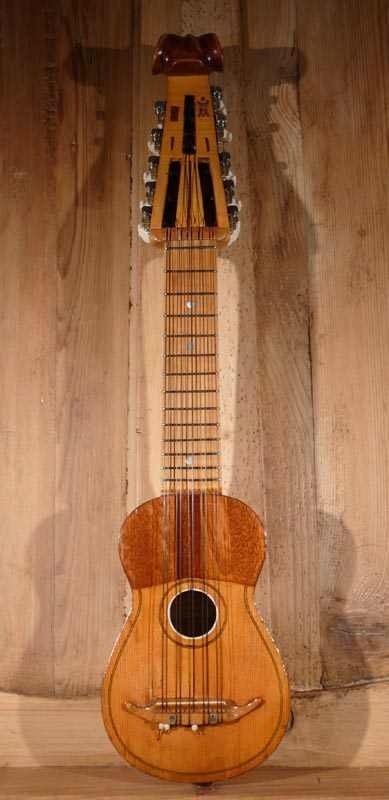
Instruments made with woods such as Naranjillo and Jacaranda demonstrate how the charango”s character depends on a conversation between material and design. A soundboard of white pine, a Jacaranda fingerboard, a stable bridge, a round sound hole, and well-fitted tuning machines are not ornamental details. Together, they determine how efficiently vibration travels, how quickly notes speak, and whether the instrument can project through an ensemble. Nylon strings generally offer a rounded and comparatively subdued response, while construction choices can add brilliance, sustain, or rhythmic definition.
The key acoustic idea is the five double courses. Ten strings are grouped in pairs, producing a dense, ringing surface when struck together. Re-entrant tuning means that the pitches do not rise or fall in a simple sequence across the courses. A higher string can sit among lower ones, creating a compact harmonic field in which open strings, stopped notes, and drones interact. This arrangement helps explain the charango”s characteristic shimmer and also its usefulness to players who alternate between chordal rhythm and fragments of melody.
- Soundboard and body: These must respond quickly without becoming excessively brittle, allowing the instrument to remain audible in fast strumming.
- Five paired courses: Accurate spacing and balanced tension are essential for the bright, unified attack associated with the instrument.
- Re-entrant tuning: Players rely on the unusual pitch layout for drones, chord color, and melodic articulation.
- Bridge and fretted neck: These transfer string energy into the body while preserving reliable intonation across the short scale.
- Sound hole and internal support: Their proportions influence projection, stability, and the balance between treble sparkle and warmth.
Strumming Defiance in the Era of Nueva Cancion
By the twentieth century, the charango had moved through several social registers. It remained tied to local celebrations and intimate forms of courtship, but it also entered urban stages and nationalist folklore projects. Since the 1920s, urban mestizo musicians had incorporated it into professional ensembles and cultural movements that sought to define national identity through Indigenous and rural sound. This was not a retreat into an untouched past. It was an argument about whose history deserved to be heard in the modern public sphere.
The political force of that argument became especially visible during the rise of nueva canción in the mid-twentieth century. Across Latin America, musicians combined traditional instruments and repertories with lyrics addressing inequality, imperial power, labor, exile, and collective dignity. Groups such as Inti-Illimani and Quilapayún helped bring highland timbres to international audiences, particularly during periods of censorship and political repression in Chile. The charango”s small body became part of a larger ensemble language that could sound intimate in one moment and openly defiant in the next.
The broader nueva canción tradition gave this musical vocabulary a continental frame. Techniques such as rapid rasgueo and the repique, with its sharply articulated rhythmic accents, could retain the energy of festive or courting music while acquiring a new public meaning. A strum that once animated a dance could now accompany a protest song, an appeal for solidarity, or a performance shaped by exile. The instrument did not need to abandon its older identity to become political. Its political strength came from carrying those older associations into circumstances where cultural memory itself was contested.
Living Heritage in the Modern Highlands
In the present day, charango makers face a practical question with historical depth: how can the instrument preserve its sonic and visual identity without depending on endangered or ethically troubling materials? The movement from armadillo shell toward carved or assembled wood is not merely a technical substitution. It reflects an effort to retain the instrument”s warmth, projection, and tactile character while acknowledging responsibilities toward wildlife and sustainable making. The best contemporary instruments treat ecological care as part of tradition rather than as an external restriction.
Meanwhile, the charango continues to inhabit both Indigenous and urban spaces. It can accompany huayno, carnaval music, yaraví, tinku, or festival repertories; it can stand beside panpipes, bombo drums, harp, violin, guitar, and voice; and it can enter modern arrangements without losing its recognizable attack. For listeners who want to approach these traditions with attention rather than simple consumption, a few steps provide a useful starting point:
- Listen for function: Notice whether the charango is supplying a drone, reinforcing rhythm, answering a singer, or carrying a melodic line.
- Compare regional voices: Seek recordings from Bolivia, Peru, Argentina, and neighboring Andean areas, remembering that construction and tuning are not uniform.
- Follow the family: Explore smaller, brighter walaychos and larger, lower-pitched ronrocos to hear how scale changes the instrument”s role.
- Read beyond the miniature-guitar description: Study Indigenous community use, mestizo urban performance, and the political history of nueva canción together.
- Support responsible makers and musicians: Ask about wood sourcing, construction, strings, and the cultural context of the repertoire.
Carrying the Chime into Tomorrow
The charango”s history is a record of transformation under pressure. European string instruments supplied an initial vocabulary, but Andean makers altered that vocabulary through local materials, compact design, paired courses, unusual tuning, and community practice. What began within the unequal conditions of colonial encounter became something more autonomous: a mestizo creation with Indigenous hands, regional identities, and a repertoire that could move between intimacy, celebration, ritual, and public dissent.
Ten nylon strings cannot contain the whole history of the Andes, but they can make that history audible in a remarkably concentrated form. The charango”s bright attack recalls older dances, courtship, and mountain festivals; its presence in nueva canción recalls censorship, exile, and solidarity; its wooden future points toward a heritage capable of adapting without surrendering its center. Regimes may attempt to silence languages, ceremonies, and collective memory. The charango answers in a register that is small enough to carry, sharp enough to be heard, and resilient enough to outlast the silence imposed around it.